Search

471 products
View:
  • Selected: 0
    Areas of use
    Loading...
  • Selected: 0
    Item names
    Loading...
  • Selected: 0
    Manufacturer
    Loading...
  • Selected: 1
    Made in
  • Selected: 0
    Additional
    Loading...
All filters
  • 24
    Areas of use
    Loading...
  • 172
    Item names
    Loading...
  • 41
    Manufacturer
    Loading...
  • Made in
  • 47
    Additional
    Loading...
View:
471 products
Ampoules with certified solutions
Ampoules with certified solutions (AS) contain solutions of a number of substances with a certified concentration. AS are designed for independent preparation by the consumer of certified combined-cycle gas mixtures while monitoring the quality of measurement results and the stability of calibration data. The use of AS for this purpose is prescribed in the methods of analysis FR.1.31.2014.17787, FR.1.31.2014.17955, FR.1.31.2015.20512, FR.1.31.2015.21296, FR.1.31.2016.23707, FR..1.31.2016.23997 and FR.1.31.2016.239967 for FGH chromatographs.
EKAN
Moscow
Produced in: Moscow
Device for automatic isolation of nucleic acids COLIBRI
from 2 840 000 ₽
1 supp.
The open system allows you to work with reagents and laboratory plastics from various manufacturers Russian-language software Modifications: - COLIBRI 24 - the ability to select from 1 to 24 samples - COLIBRI 48 - the ability to select from 1 to 48 samples - COLIBRI 96 - the ability to select from 1 to 96 samples Range of working volumes: - COLIBRI 24 - 200 – 5000 mkl - COLIBRI 48 - 30 – 1000 mkl - COLIBRI 96 - 20 – 1000 mkl A unique format of consumable plastic - 8-hole strips and combs Two built-in thermostats The accuracy of temperature maintenance is ± 1 °C Heating/cooling - up to 100 °C / up to 35 °C Universal Thermostat Tube Unit Built-in computer Ready-made allocation protocols The time of one extraction cycle is from 11 minutes Built-in bactericidal UV lamp for interior treatment
SYNTOL
Москва
Produced in: Moscow
GeneMack Strela Automatic Nucleic Acid Isolation Station
1 supp.
The Strela automatic nucleic Acid isolation station is suitable for laboratories with a small sample flow seeking to optimize workflow and improve reproducibility of results. The station is being developed and assembled in Russia. Station Features: • Separation on magnetic particles – high yield of nucleic acids and excellent purity • The quality and concentration of the resulting DNA is sufficient for all molecular applications, including NGS • Ability to work with different types of samples, including complex samples (whole blood, FFPE, cfDNA, dry blood stains, saliva, hair, nails, etc.) • Simultaneous isolation of 1 to 13 samples • About 30 minutes per allocation, depending on the protocol • No overspending of plastic – load exactly as many cartridges as you are going to allocate samples • A large number of built-in protocols, the ability to program your protocols for different cartridges • User-friendly and intuitive interface • The station is compatible with cartridges from different manufacturers • 24/7 technical support in Russian Technical specifications Device Type: Desktop automatic device Minimum load: 1 sample Maximum load: 13 samples Reagent format: Bottled and sealed in individual cartridges Protocol execution time: From 16 to 60 minutes (depending on the allocation protocol program) Dosage volume: 25-1000 µl Dosing accuracy: No more than 5% CV Control: LCD Touch screen, 7 inches, 1025x600 Software language: Russian Heating unit with temperature control: from 30C to 80C (at room temperature+ 25C) UV lamp: Available Input voltage: 220V Overall dimensions (W x L x H): 54 x 57 x 61 cm Weight: 60 kg The installation location is only indoors Ambient operating temperature 15-40°C
Aivok
Zelenograd
Produced in: Moscow, Zelenograd
LAMPIX V Portable instrument for real-time isothermal DNA amplification, 1 channel, 2×0.2 ml
1 supp.
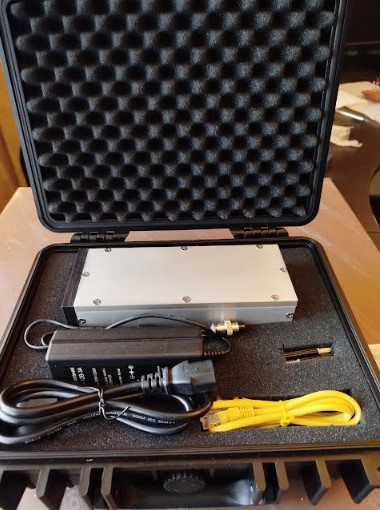
Super-compact DNA amplifier with real-time recording of results for isothermal amplification of nucleic acids. Designed to work with 2 samples and fits in the palm of your hand.
DNA amplifier with real-time recording of results for isothermal PCR amplification of nucleic acids (LAMP and RT-LAMP). The compact device is designed to work with 2 samples, maintains the required temperature for setting up the reaction and reads the analysis result. The software that comes with LAMPIX V allows you to set analysis parameters and save the result. Wireless connection via Bluetooth is possible.
Technical characteristics of the LAMPIX V amplifier:
  • thermal block format - 2×0.2 ml;
  • number of fluorescence measurement channels - 1;
  • compatibility with dyes - FAM, SYBR Green, EvaGreen; excitation source - LED;
  • fluorescence detector - photodiode;
  • excitation source wavelength, nm - 470;
  • detection wavelengths, nm - 510-530;
  • type of tubes - 0.2 ml tubes with a flat cap;
  • temperature range, °C - 37–75;
  • temperature maintenance accuracy, °C — ±0.5;
  • interfaces for connecting to a PC/laptop - USB type C, Bluetooth;
  • power supply - external power supply 5 V / 2.5 W, power bank;
  • Software for managing and analyzing results - Win 7-10, Android;
  • dimensions, L×W×H, mm – 45x45x65;
  • weight of the device, g - 60. Delivery set: real-time DNA amplifier;
  • external power supply;
  • cable for connecting to a computer USB type C;
  • Software in English;
  • instructions in Russian;
  • PC (or laptop) not included;
  • 1 year warranty;
  • It is possible for a technical specialist to visit for training (optional).
Aivok
Zelenograd
Produced in: Moscow, Zelenograd
MAESTRO-αMS gas chromatograph by Interlab
We offer expert laboratories of physicochemical methods of analysis a gas chromatograph with a quadrupole mass spectrometric detector «MAESTRO-αMS». Quadrupole GC-MS «MAESTRO-αMS» is in demand for targeted research (screening) and non-targeted search. In targeted studies, it is necessary to detect given target compounds in samples of various nature and origin at the level of residual amounts, for example, several picograms of the target compound in the injected 1 μl of liquid sample. Most often, targeted research is carried out in the following areas of laboratory screening: ecology, food safety, clinical monitoring, narcology, doping control, production control of various raw materials. In targeted studies, it is often required not only to confirm the presence of a compound in a sample, but also to determine the level of its content quantitatively, since both the list of target compounds and the permissible level of their presence in the sample are specified by regulatory documents. Quantitative analysis requires standards for the substances you are looking for. When conducting a non-target search, as a rule, it is required to analyze a sample of unknown composition, in other words, to find as many compounds as possible in the sample and identify (identify) each of them. Since the identification of a detected compound is carried out by comparing its experimental mass spectrum with the spectrum of a pure substance obtained under standard conditions, this task requires reference libraries of mass spectra of pure substances, as well as tools for working with mass spectra, for example: algorithms for cleaning experimental mass spectra from background and spectral noise (mass spectrum deconvolution algorithms), library search and comparison algorithms. An off-target search is called a qualitative analysis, since the researcher is primarily interested in the list of detected substances, and not in the quantitative assessment of their content in the sample. When creating MAESTRO-αMS, we took into account our own many years of experience in operating imported analogues. We have made the device inexpensive. We have made the device compact: The modern design of the device made it possible to make the MAESTRO-αMS really compact, so that the device occupies the smallest possible area on the laboratory table. The layout of the device allows you to remove the ion source on the front flange for cleaning and replacing the cathodes, if necessary. We have reduced the cost of operation: When developing the MAESTRO-αMS, we sought to increase the resistance of the device to sample matrices and use a minimum of consumable materials in order to eliminate downtime for maintenance and replacement. As a result, we have created an extremely stable ion source and a perpetual photomultiplier detector. We have created special software: Even at the first acquaintance with the software, it becomes obvious that being in the window of each button and each parameter to be changed is expedient and logical. Our software product was created for the convenience of the operator, so we implemented the necessary and eliminated the unnecessary. We used the principle of one active window, in which the operator moves sequentially step by step, performing hardware settings, setting the data collection method, subsequent processing algorithms, templates for presenting the results. MAESTRO-αMS offers a wide range of scanning modes, built-in algorithms for working with mass spectral data, convenient unloading of initial data arrays for their processing in specialized software packages, graphics export for presentations and scientific publications. You can use several libraries of mass spectra at the same time, or create your own for your typical tasks. Finally, we provide a 5-day training course for professionals who want to understand the theoretical foundations of the method and their implementation in the hardware of modern quadrupole GC/MS. The volume and depth of presentation of the material from the developers of the device is intended to lay the foundation for the effective use of «MAESTRO-αMS» in the future. Some technical characteristics of MAESTRO-αMS: • Instrumental detection limit (SIM, OFN @272 m/z ) < 10 fg; • Scan modes: scan for selected ions, full scan in a given mass range, combined scan mode; • The number of simultaneously connected libraries of mass spectra is at least 10.
Produced in: Moscow
Nanolab based on NTEGRA PRIMA AFM
Scanning Probe Microscopy In air and in liquid: AFM (contact + semi-contact + non-contact) / Lateral Force Microscopy/ Phase Mapping/ Force Modulation/ Adhesive Force Mapping/ Lithographs: AFM (Power) Only in air: STM/MSM/ESM/SEM/ Kelvin Probe Method/ Display of Spreading Resistance/ AFAM (on demand)/Lithographs: AFM (Current), STM/.
NT-MDT
Zelenograd
Produced in: Moscow, Zelenograd